Navigating the Tealfabric Library
Document information
| Field | Value |
|---|---|
| Canonical URL | /docs/01_introduction-and-concepts/09_navigating-in-library |
| Version (published date) | 2026-08-14 |
| Tags | documentation, reference, index |
Summary
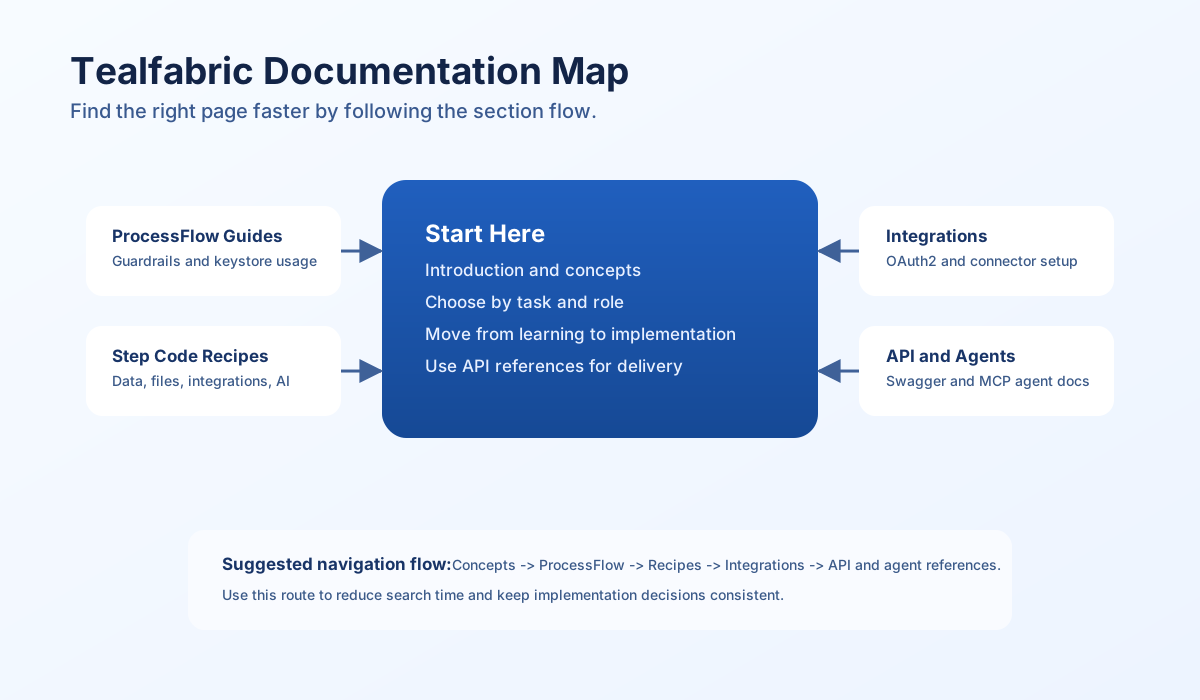
This page helps you find the right Tealfabric documentation quickly, whether you are onboarding, building automations, integrating external systems, or working with APIs. Use it as your map to the main documentation areas and as a shortcut index for high-value pages. Following this structure reduces time spent searching and helps you move from question to action faster.
How to use this library
The Tealfabric Library is organized by user intent, so you can begin with the section that matches your immediate goal. If you are new, start with concepts and platform orientation; if you are implementing, go directly to automation, code recipes, or API references. This approach keeps learning focused and avoids unnecessary context switching.
Prefer a Learning path when you want a short, ordered journey of existing Library pages for a persona and outcome. Paths are virtual sequences—they do not duplicate content.
Sidebar navigation mirrors the document hierarchy and is the fastest way to move between related topics. Because sections are grouped by workflow area, you can drill down from high-level concepts into practical implementation material without losing context. Staying inside one section until you finish a task usually leads to a clearer learning path.
Start with platform fundamentals
If you are learning Tealfabric for the first time, start with the User guide for the live interface, navigation labels, and common tasks. That page also summarizes the core vocabulary you will see everywhere else: tenant (organization boundary), ProcessFlow (automation logic), steps, triggers, connectors, WebApps, and sandbox execution. Once that mental model is in place, technical sections below are easier to follow.
Build and run automations
Use ProcessFlow documentation when your task is workflow orchestration, runtime behavior, and secure step-level execution. These pages explain what step code can do, how to handle secrets safely, and how to design reliable process behavior in real tenant environments.
- Process sandbox
tfAPI reference - Sandbox guardrails — execution boundaries, allowed patterns, and filesystem rules
- ProcessFlow Keystore — secure secret storage and usage in process steps
Write step code with recipes
When you need implementation patterns, go to the step code section and select a recipe by problem type instead of browsing randomly. These recipes are designed as practical references for common operations such as data shaping, validation, integrations, and process-to-process coordination.
Start here for the section overview:
- Writing step code — entry point for all ProcessFlow coding guides
Then use these focused recipe groups:
Data operations
- Data transformation & mapping
- String processing & text
- Date & time operations
- Math & statistics
- Array & collection operations
- JSON, XML & CSV parsing
Validation and security
Files and content handling
Communication and integrations
Database, AI, and logic
Connect external systems and APIs
If your work involves external identity, service connectivity, or direct endpoint testing, use the integration and API reference pages as your primary source. These sections provide the most reliable path for authentication setup, request design, and endpoint discovery.
- OAuth2 authentication — configure OAuth2-based integrations
- API endpoints — HTTP API contract reference (parameters, schemas, examples)
For agent-focused workflows:
- Trace AI Agent — MCP chat with on-demand tenant skills
- AI adoption advisor — Trace-assisted AI roadmap and JWT engagement app
- Autonomic Agents — unattended event-woken workers (not in the chat picker)
- Tenant skills user guide — author skill packages under
SKILLS/ - Platform Engineer Agent — MCP-enabled agent usage and API patterns
Partner data services
When a workflow needs supplemental reference data that Tealfabric does not maintain, use a tested partner API. Call it from a GET / receive integration in ProcessFlow the same way as any other REST source (OpenSanctions screening uses POST / send). Some partners need a vendor key; some (such as PRH BIS) are free public GET APIs.
- Partner services — what these pages cover and how to wire a partner
- REST Countries — ISO codes, currencies, calling codes, memberships; plans
- Finnish Business Information System (PRH) — Finnish company search (free); financial statements via Virre purchase
- OpenSanctions — sanctions and PEP screening; API docs
- OpenCorporates — multi-jurisdiction company search; API reference
- Socrata Open Data API (SODA) — city and agency open data; dev.socrata.com
Quick path by role
Choose the entry point that best matches your current role and objective. New users should build conceptual confidence first, developers should prioritize recipe-driven implementation, and integration teams should work from API and authentication references. Starting in the right section usually shortens troubleshooting and improves implementation quality.
- New users: User guide (then this page when you need a documentation map)
- Developers: Writing step code
- Integration engineers: API endpoints
Final recommendation
Use this page as a stable navigation index whenever you return to the Tealfabric docs after a break or when switching between project phases. Follow the section flow from concepts to implementation, then to integrations and API references as your work matures. This habit keeps documentation usage consistent and helps teams align on the same source of truth.